
Why Cloud Projects Fail, and How Strong Discovery Prevents It
Why Cloud Projects Still Fail Despite Modern Technology
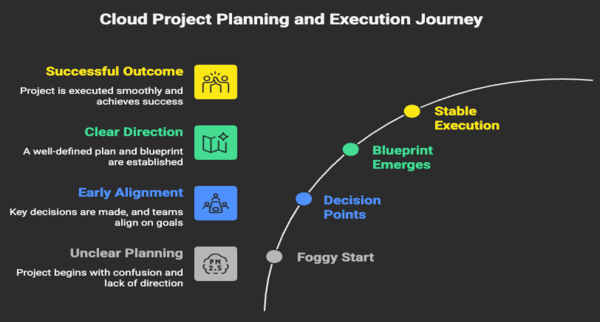
Cloud platforms today are powerful, mature and well-documented. Yet cloud projects continue to miss timelines, exceed budgets or fail to deliver expected business outcomes.
In most cases, failure is not caused by the cloud itself. It stems from weak discovery at the start of the project.
When objectives are unclear, assumptions go unchallenged or success metrics are not defined early, even the best engineering teams struggle to deliver meaningful results. For founders, CTOs and product leaders, discovery is not a formality, it is a critical risk-reduction phase.
Strong discovery aligns business intent with technical execution before costly decisions are locked in.
What “Poor Discovery” Looks Like in Practice
Many cloud initiatives begin with good intentions but insufficient clarity. Common discovery gaps include:
Vague problem statements instead of clearly defined business goals.
Assumptions about scale, traffic or usage patterns.
Undefined success metrics beyond “go live”.
Limited understanding of legacy constraints or dependencies.
Premature solution selection before validating requirements.
These gaps often surface later as scope creep, rework, architectural changes, or stakeholder frustration.
By the time issues appear in delivery, fixing them becomes expensive and disruptive.
The Business Cost of Skipping Proper Discovery
When discovery is rushed or overlooked, the impact is not just technical, it directly affects business performance.
Organizations often experience:
Delayed launches due to unclear or changing requirements
Budget overruns caused by mid-project re-architecture
Systems that technically work but fail to deliver real value
Low adoption because workflows do not match user needs
Increased operational overhead from poorly aligned architectures
In high-growth environments, these issues compound quickly and can stall momentum at critical stages.
What Strong Cloud Discovery Actually Involves
Effective discovery is not about producing long documents. It is about creating shared understanding and informed decisions.
A strong cloud discovery phase typically focuses on:
Business objectives: What outcomes matter most and why
User journeys: How customers or internal teams will actually use the system
Constraints: Budget, timelines, compliance, and legacy dependencies
Scalability needs: Expected growth patterns and peak usage scenarios
Success metrics: How progress and impact will be measured
Architectural direction: Trade-offs between simplicity, speed, and future scale
This process ensures that architecture and delivery decisions are grounded in real business context.
Why Discovery Accelerates Delivery Instead of Slowing It Down
Discovery is often perceived as a delay. In reality, it is what enables faster and more predictable execution.
When discovery is done well:
Engineering teams make fewer assumptions
Architecture decisions remain stable throughout delivery
Dependencies and risks are identified early
Stakeholders stay aligned as the project evolvesTeams spend less time reworking or course-correcting
Projects that invest time upfront typically move faster once development begins and finish closer to plan.
Discovery as a Leadership Responsibility
While discovery involves architects and engineers, its success depends heavily on leadership participation.
Founders, CTOs, and product leaders play a critical role by:
Clarifying priorities and trade-offs
Aligning technical work with business outcomes
Validating assumptions earlyDefining what “success” really means
Discovery works best when it is treated as a collaborative decision-making phase, not a handoff to engineering.
Discovery in Practice at Cloudforgers
At Cloudforgers, discovery is treated as a foundation, not a checkbox.
Teams work closely with stakeholders to:
Translate business goals into clear technical direction
Identify risks and constraints before delivery begins
Design architectures that balance speed, scale, and cost
Create realistic roadmaps aligned with business priorities
This approach helps ensure cloud projects start with clarity and finish with confidence — a key reason clients consistently highlight quality, communication, and reliability in Cloudforgers’ 5-star Clutch reviews.
Final Thoughts
Cloud technology does not fail projects, unclear thinking does.
Strong discovery reduces risk, improves alignment, and enables teams to build systems that actually deliver value. For organizations investing in cloud platforms, discovery is not optional; it is the difference between momentum and costly rework.
If you are planning a cloud initiative or struggling with delivery challenges, revisiting discovery may be the most effective place to start.

Comments